

You do not have to go hard for movement to count
Gentle movement is physical activity, even when it happens in short sessions. It can contribute to health, especially when it replaces sitting. UK physical activity guidance says any activity is better than none. Moderate intensity is useful, but not every session needs to feel demanding for movement to be worthwhile.
Published by Vibe Dance Fitness
Editorial note: Vibe uses AI-assisted tools when preparing articles. Individual author and reviewer names appear only when their contributions have been confirmed. About Vibe’s publishing process.
Do short sessions and gentle movement count?
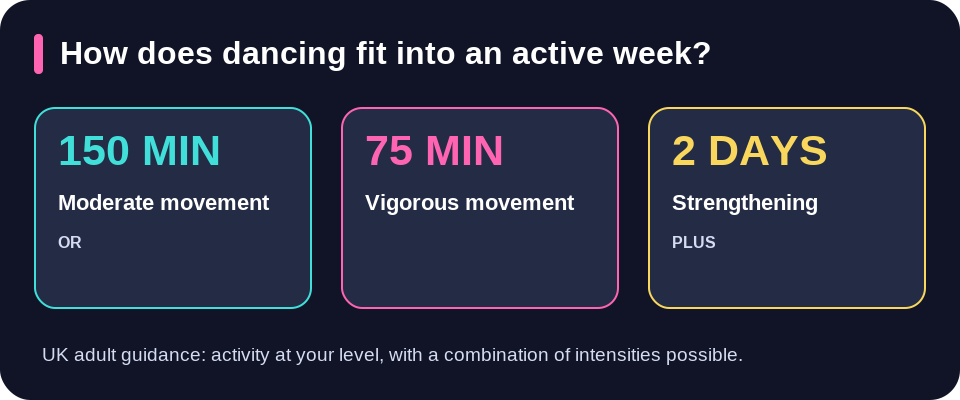
Small amounts of movement are worth doing, even if they do not look like a conventional workout. The UK Chief Medical Officers advise adults to aim for 150 minutes of moderate activity per week, or 75 minutes of vigorous activity, and to strengthen muscles on two days. They also make clear that any activity is better than none and that moving from inactivity towards more activity brings benefits. A short, low-impact dance routine may not count as vigorous exercise, and that is fine. It can still break up sitting, provide practice with coordination and help someone build a routine. For a person with limited energy, mobility restrictions, disability or a long gap since exercise, the safest achievable starting point may be a few minutes at a time. Rather than judging a session by sweat or exhaustion, consider whether it was suitable, repeatable and comfortable enough to return to.
Guidance behind this topic
These primary guidance pages cover the wider subject. They are not substitutes for the studies cited in this article.
Fitness culture has spent years teaching people that effort only counts if it looks dramatic. The 2026 UK physical activity guidance is much less theatrical: every minute counts.
The biggest jump is from none to some
The UK Chief Medical Officers say the greatest health gains occur when people move from inactivity to any level of activity. Benefits continue to build as activity increases, but “some” is not a consolation prize on the way to “proper exercise”.
The guidance also says activity can be accumulated in bouts of any length. That matters for anyone whose energy, pain, concentration, caring responsibilities, work or disability makes a perfectly planned hour unrealistic.
Lower impact is still movement
In a dance class, you can reduce impact without becoming stationary. Step instead of jump. Keep the arms smaller. Remove turns. Slow the range of motion. Take thirty seconds out and rejoin.
Your intensity may shift across a session. That is normal physiology, not bad character.
Short sessions can be useful too
The NHS encourages people to start gradually and build up. If ten minutes is available, ten minutes exists. If one song is all your brain will agree to, one song is movement.
A smaller version you actually do can be more useful than the perfect version that lives permanently in tomorrow.
There is still value in progression
None of this means challenge is bad. Building fitness usually involves gradually asking more of your body. The point is that progression works better when it grows from a baseline you can tolerate and repeat.
At Vibe, “find your level” means you can turn the dial rather than switch the whole activity on or off. Some weeks you may want bigger moves and more intensity. Other weeks, turning up and moving gently may be the win.

- Every minute of activity can contribute.
- Lower-impact movement is not automatically low-value movement.
- Shorter bouts can be useful and easier to repeat.
- Progression works best when it starts from a level you can actually sustain.
Sources and further reading
We link the evidence so you can read beyond our summary. Research quality varies, and an association is not automatically proof of cause.
Want to know more about the people behind Vibe? Meet founder Matt Campbell.
Editorial transparency: Vibe uses AI-assisted tools during editorial preparation. These articles are published under the Vibe Dance Fitness name until individual writer and reviewer credits have been confirmed. We link supporting research where available; please check the original guidance when making decisions about your health.
Try it your way
Find your level, then change it whenever you need to.
Vibe routines are designed so you can make them bigger, smaller, higher or lower impact.
Try Vibe