
Does dancing count as exercise? Yes. Here’s what the UK guidance actually says
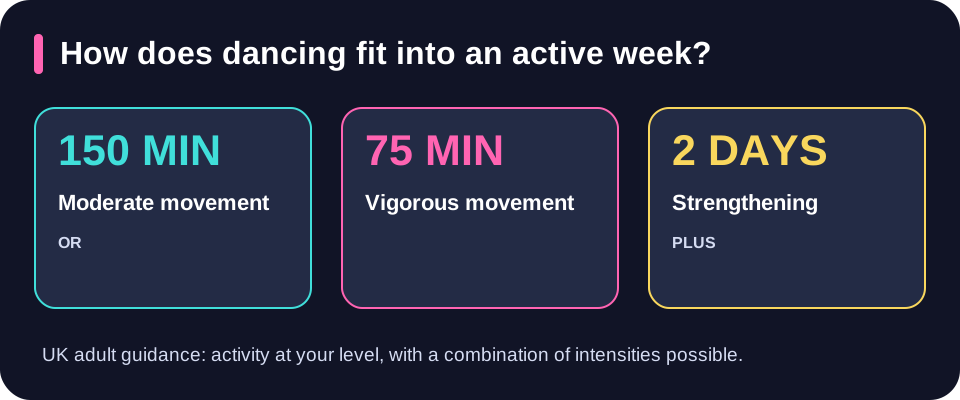
Dancing is physical activity, and some styles count as moderate or vigorous exercise when your breathing and heart rate rise. UK guidance suggests adults aim for 150 minutes of moderate activity, or 75 minutes of vigorous activity, each week, alongside strengthening work on two days. Start at a manageable level and build up gradually.
Published by Vibe Dance Fitness
Editorial note: Vibe uses AI-assisted tools when preparing articles. Individual author and reviewer names appear only when their contributions have been confirmed. About Vibe’s publishing process.
Does dancing count towards your weekly exercise?
Dancing can count towards the physical activity recommended for adults in the UK. The Chief Medical Officers advise at least 150 minutes of moderate-intensity activity per week, or 75 minutes of vigorous activity, together with muscle-strengthening work on at least two days. What matters is effort, not whether the activity happens in a gym. A dance class may be moderate intensity if it raises your breathing and heart rate while still letting you speak. Some people will work harder; others will need a gentler pace. Either can be a useful way of moving. A class does not automatically meet the entire weekly recommendation, and dancing alone may not cover the strengthening element. People returning after time away, living with disability or managing a health condition can start with a manageable amount and adapt the movements. The NHS and UK guidance recognise that some activity is better than none, and gradual progress matters.
Guidance behind this topic
These primary guidance pages cover the wider subject. They are not substitutes for the studies cited in this article.
If your brain still pictures “real exercise” as treadmills, burpees and somebody shouting about your core, the official guidance has some useful news: dancing counts.
What counts as moderate activity?
The NHS describes moderate-intensity activity as movement that raises your heart rate, makes you breathe faster and makes you feel warmer. Dancing is listed as an example. A simple test is whether you can still talk but would struggle to sing.
The refreshed 2026 UK Chief Medical Officers’ guidance keeps the familiar target of at least 150 minutes of moderate activity a week, or 75 minutes of vigorous activity, or a mixture. More importantly, it emphasises that any activity is better than none, and that the largest gains can happen when somebody moves from doing very little to doing something.
You do not have to turn every dance class into a personal survival documentary for it to be worthwhile.
A class can contain different intensities
Dance is rarely one neat intensity from first beat to last. A warm-up might be light. A faster routine might be moderate or vigorous. A lower-impact version may still raise your breathing and heart rate. Taking a breather does not erase the movement you have already done.
That matters because a useful fitness routine has to survive contact with real life. Energy changes. Joints complain. Sleep goes rogue. Work gets busy. An approach that allows you to scale movement up or down can make consistency more realistic.
What about strength?
The UK guidance also recommends activities that build or maintain strength on at least two days a week. Some forms of dancing can contribute to muscular work, especially through repeated squats, lunges, changes of level and controlled movement, but dance does not automatically cover every strength need for every person.
The Vibe version
At Vibe we use a choose-your-own-intensity approach. Bigger steps, smaller steps, more bounce, less bounce, a pause for water: the goal is not to perform one “correct” effort level. It is to find a level you can actually use.
If a class gets you moving, raises your breathing for part of the session and helps you return next week, that is not second-rate exercise. It is exercise with music and considerably fewer grey machines.
- Dancing can count towards your weekly physical activity.
- Moderate intensity is about your body’s response, not whether an activity looks traditionally ‘sporty’.
- Any activity is better than none, and sessions can mix light, moderate and vigorous movement.
- Adaptable movement can make consistency easier to sustain.
Sources and further reading
We link the evidence so you can read beyond our summary. Research quality varies, and an association is not automatically proof of cause.
UK Chief Medical Officers’ physical activity guidelines, updated 2026
Official UK guidance on recommended activity, intensity, strength and the value of moving from inactivity to some activity.
NHS Better Health: How to be more active
NHS guidance lists dancing as an example of moderate-intensity activity.
Want to know more about the people behind Vibe? Meet founder Matt Campbell.
Editorial transparency: Vibe uses AI-assisted tools during editorial preparation. These articles are published under the Vibe Dance Fitness name until individual writer and reviewer credits have been confirmed. We link supporting research where available; please check the original guidance when making decisions about your health.
Try it your way
Want to try exercise that doesn’t feel like a punishment?
Book a Vibe class and choose your own level throughout. No dance experience required.
Find a Vibe class