

Nervous about your first dance fitness class? Read this before you talk yourself out of it
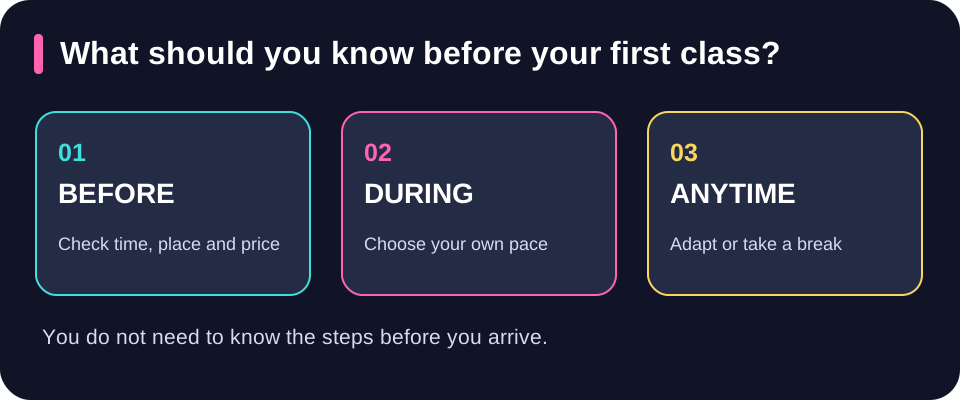
A beginner-friendly dance fitness class is a place to move without needing to know the steps in advance. Stand wherever you feel comfortable, follow what you can and take breaks. The instructor should explain how the session works and offer easier versions of moves before expecting anyone to keep up.
Published by Vibe Dance Fitness
Editorial note: Vibe uses AI-assisted tools when preparing articles. Individual author and reviewer names appear only when their contributions have been confirmed. About Vibe’s publishing process.
What if you are nervous about your first dance fitness class?
Feeling nervous before a first dance fitness class is understandable, particularly if exercise spaces have previously felt competitive or judgemental. You do not need to learn a routine in advance, arrive with a friend or match the movement of the person next to you. Practical preparation can help: check the venue and accessibility, wear clothes that let you move, bring water and give yourself time to find the room. During the class, try a lower-impact version, rest or step out whenever you need to. In a beginner-friendly setting, the instructor should welcome questions and explain that mistakes are normal while learning. A class may last an hour, but there is no requirement to perform every minute at full intensity. If the environment does not feel supportive, that is useful information about the class, not evidence that you failed. The goal of a first visit is to find out whether this kind of movement suits you.
Guidance behind this topic
These primary guidance pages cover the wider subject. They are not substitutes for the studies cited in this article.
The hardest move in many dance classes happens before the music starts. It is called “walking through the door while your brain invents twelve reasons everybody will be looking at you”.
You are allowed to be new
You do not need to learn routines before attending. You do not need the correct leggings. You do not need to arrive with a friend. You definitely do not need to achieve confidence in advance, as though confidence is an entry ticket.
A beginner-friendly class should be designed for people who do not already know what they are doing.
Your brain may exaggerate the spotlight
When you feel self-conscious, attention can turn inward. Every wrong foot feels enormous. In reality, most people are using a surprising amount of processing power to remember their own next move.
A 2025 systematic review looking at dance, social physique anxiety and physical self-esteem found that dance interventions were associated with improved physical self-esteem and confidence and reduced social physique anxiety across the studies reviewed. That does not mean one class will dissolve self-consciousness, but it supports a more hopeful direction of travel.
Choose a modification before you need it
Give yourself permission in advance to step instead of jump, miss an arm, stand near the back, take water or sit out a track. Making a plan before anxiety spikes removes a tiny negotiation from the moment.
You cannot fail a dance fitness class by doing a smaller version of the move.
What Vibe tries to do differently
We teach the room rather than reward the front row. You will see options. You can scale intensity. There are no auditions and nobody is promoted to Head of Knowing The Choreography.
The NHS recommends choosing ways to move that you enjoy and that fit your health, lifestyle and ability. That sounds simple, but it is a useful standard. The activity should adapt towards real people, not demand real people turn themselves into ideal participants first.
One job
If you are nervous, your only job for class one is to arrive. You can decide what you think of it afterwards, with actual evidence rather than the trailer your anxiety made in the car park.
- You do not need confidence before your first class.
- Most people are concentrating on their own movement, not grading yours.
- Pre-deciding your modifications can reduce in-the-moment pressure.
- Your first session is information, not an exam.
Sources and further reading
We link the evidence so you can read beyond our summary. Research quality varies, and an association is not automatically proof of cause.
2025 systematic review: dance, social physique anxiety and physical self-esteem
Reviewed 16 studies across several forms of dance and reported favourable changes in physical self-esteem and social physique anxiety.
NHS Every Mind Matters: Be active for your mental health
Encourages people to move at their own pace and choose activities that fit their life and abilities.
Want to know more about the people behind Vibe? Meet founder Matt Campbell.
Editorial transparency: Vibe uses AI-assisted tools during editorial preparation. These articles are published under the Vibe Dance Fitness name until individual writer and reviewer credits have been confirmed. We link supporting research where available; please check the original guidance when making decisions about your health.
Try it your way
Come exactly as new as you are.
No auditions, no requirement to know the choreography and no pressure to keep up.
Book your first class